
On the 6th September 2025 Centre-UB Postdoctoral Research Fellow Dr Sally Reynard hosted a public engagement event at The Exchange in Birmingham with her Fellowship collaborators Get Ahead Mindset.
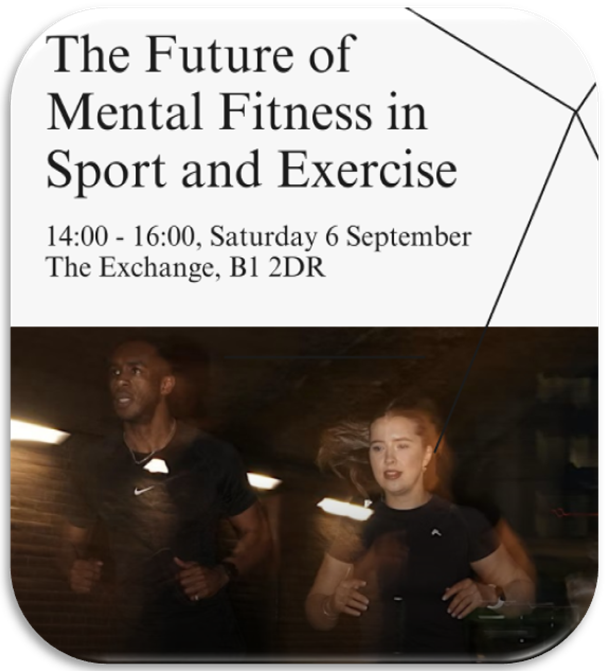
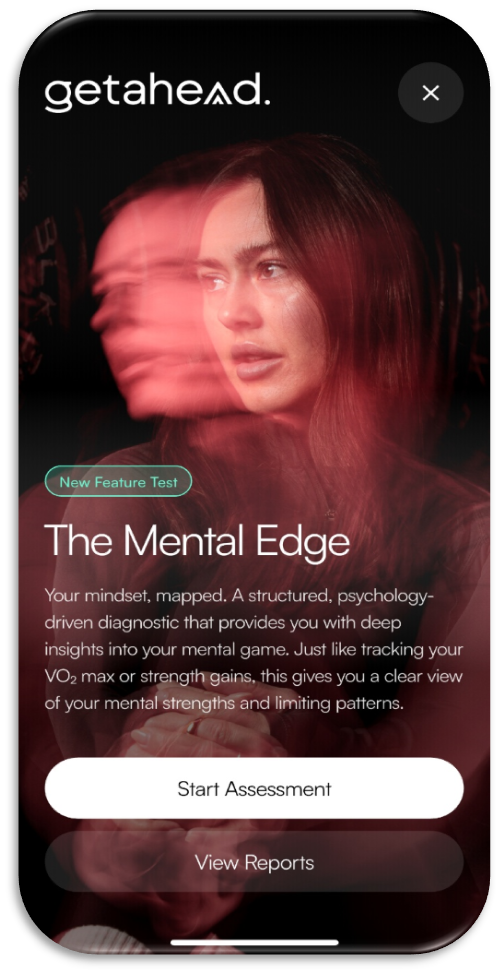
The event, titled ‘The Future of Mental Fitness in Sport and Exercise’, explored how technology is being used to increase access to sport psychology beyond elite athletes. Get Ahead Mindset—a start-up founded by Chris McAdam and Adam Dehaty—have created a new smartphone app that trains psychological skills to support individuals to reach their sport and exercise goals.
Keep reading to find out about the event, including key insights about the science, theory and framework behind Sally’s Fellowship with Get Ahead Mindset!
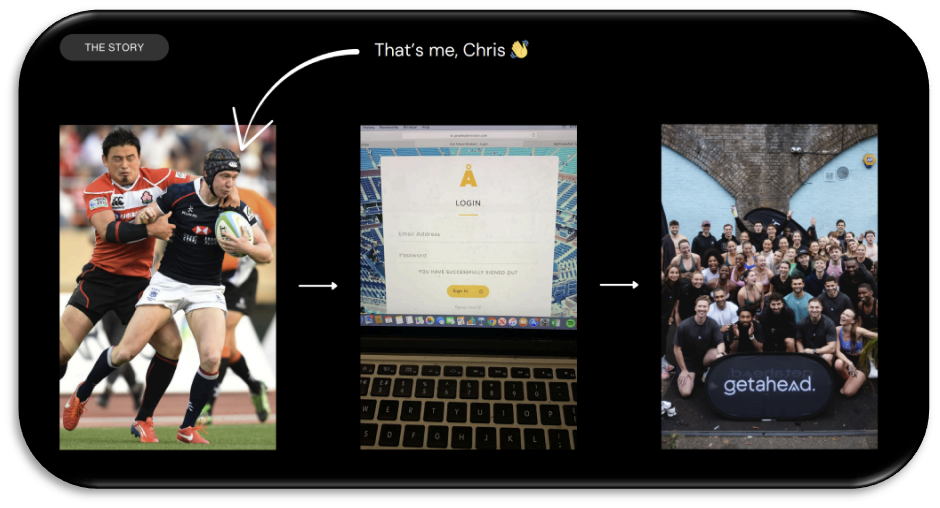
After finding out about the story of the Get Ahead Mindset app and its creation and evolution over time from Chris, attendees were taken on a deep dive into a key psychological skill that is trained in the app—emotion control.
What is emotion control? Emotion control is how we manage our emotional reactions in the moment.
Emotion control deep dive
First, Sally talked through the findings of newly published research which is shedding light on the importance of our emotions when we’re taking part in sport and exercise.
Researchers assessed participants blood lactate (a measure of metabolic exertion), VO2 (a measure of cardiorespiratory exertion), self-report positive vs negative emotion, and performance motivation within an endurance cycling test1. They found that when participants blood lactate increased this predicted a decrease in positive emotion. In turn, this decrease in positive emotion predicted a reduced desire to achieve physical performance goals within the cycling test. The same pattern was observed with VO2. The researchers concluded that the participants emotions acted as a mediating bridge in the link between their physiological responses to endurance exercise and their performance motivation.
What does this mean? Our emotions may shape our experience of sport and exercise, and our ability to reach our sport and exercise goals. So, supporting athletes and exercisers to learn how best to manage emotions is vital.
Next, Sally introduced attendees to the Extended Process Model2 of emotion control, applied to a sport and exercise context. The Extended Process Model is a key theory that can be used to help us understand emotion control and develop evidence-based ways to train it as a psychological skill. It states that our emotional experiences and our ability to control them are strongly linked, but separate psychological systems.
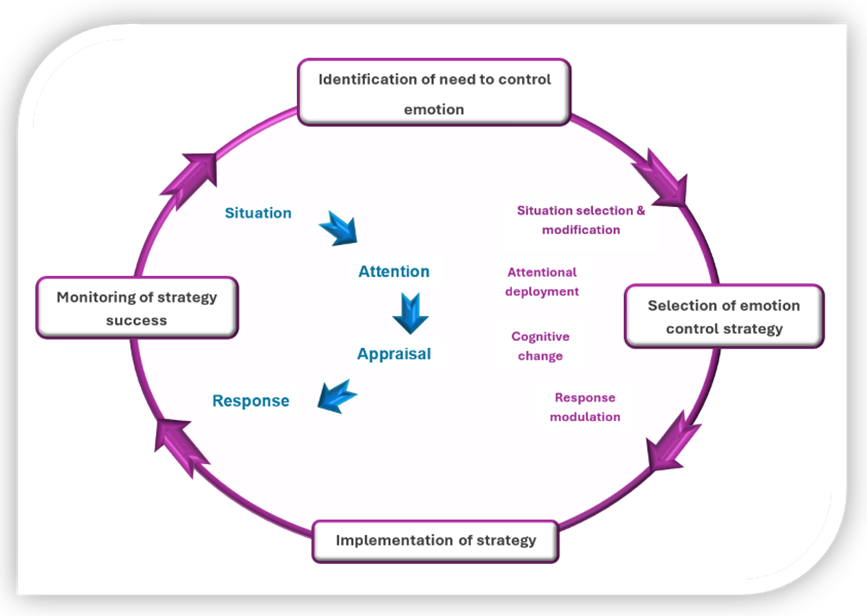
We can see this represented in the diagram above, where the blue emotion generation cycle moves sequentially from a situation a person is in to the emotional features of the situation that the person pays attention to (e.g., a person is at a running event and they watch a person speed past them just after the start); through to the appraisal of those attended features in relation to the person’s emotional goals (e.g., they interpret that negatively as an indication of their own running abilities)—leading to their emotional response. An example of an emotional response could be an increased breathing rate.
Embedded around this emotion generation system is the emotion control system. This uses the emotional response as its input to identify whether the emotion needs to be controlled or managed. Then, a suitable strategy is selected. Different groups of strategies are represented at different stages of the emotion generation sequence within a selection stage. The chosen strategy is then implemented, and the emotion control system is monitored and recalibrated iteratively over time.
An example of a cognitive change emotion control strategy is cognitive reappraisal. This can be used to rethink an initial interpretation of a situation to be more positive. So, the person in our example could remember that they achieved a personal best in the running event just last month, and some people just like to start quickly.
Early-stage evaluation
Returning from the deep dive, Sally presented initial findings of an early-stage pilot evaluation study of the Get Ahead Mindset app. This research, informed by the Medical Research Council’s Complex Intervention Development and Evaluation Guidelines, formed part of Sally’s Centre-UB Fellowship and aimed to understand different users’ experiences of acceptability (how much we like something) and feasibility (how much something can be used as intended) of the app. The findings of this research will shape the further development of the app before larger-scale evaluation trials.
A key recommendation from Sally’s research is focused on the need for optimisation of user engagement in the app.
**Watch out for a future blog post where Sally will share more details about the findings of the early-stage evaluation study!**
Whilst indulging in some very tasty snacks and drinks provided by Food Fellows, attendees tried out the new preview version of Get Ahead Mindset’s app and took part in an insightful and lively open Q&A related to its features and iterative development.
Optimising engagement
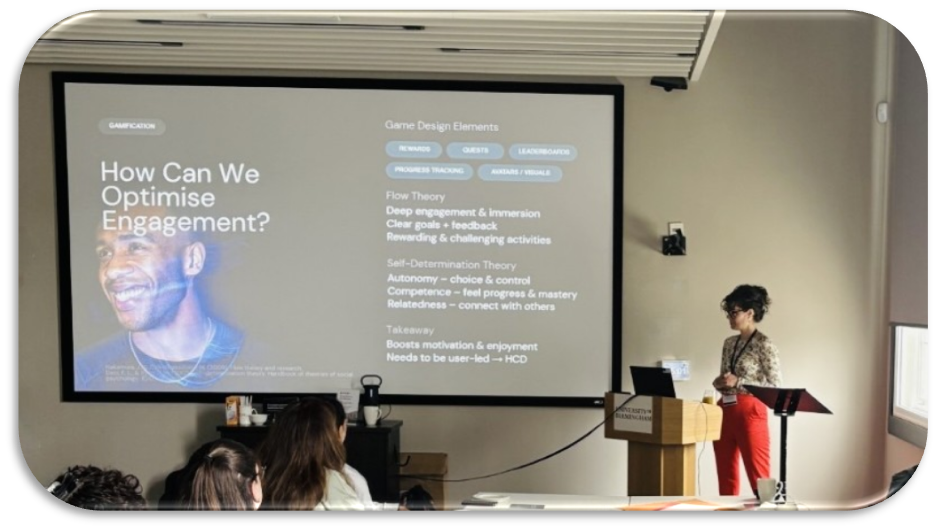
Reflecting on the need for enhanced user engagement in the Get Ahead Mindset app, the final part of the event gave attendees the opportunity to get creative and learn about the use of gamification and human-centered design in app development.
Gamification: the use of game design elements (e.g., leaderboards, rewards, quests) in non-game contexts such as apps, can support users’ motivation and enjoyment—leading to increased engagement.
Tasked with the challenge of ‘Designing the Future’, attendees came up with ideas for how to use gamification to track progress and optimise engagement in the Get Ahead app. From personalised graphs and figures, big interactive visuals, to buddy systems and storytelling, attendees came up with lots of fantastic ideas that were discussed and reflected upon by all.
Like the sound of gamification? Check out Sally’s blog post on gamification to learn more!
Get Ahead Mindset: https://www.linkedin.com/company/get-ahead-mindset
Sally: www.linkedin.com/in/drsallyreynard
References
- Wellings, I. G., Ferguson, R. A., & Taylor, I. M. (2025). Affect mediates the relationship between physiological and motivational responses to exercise. Journal of Sports Sciences, 1-9. https://doi.org/10.1080/02640414.2025.2540216
- Gross, J. J. (2015). The extended process model of emotion regulation: Elaborations, applications, and future directions. Psychological Inquiry, 26(1), 130-137. https://doi.org/10.1080/1047840X.2015.989751
- McRae, K., & Gross, J. J. (2020). Emotion regulation. Emotion, 20(1), 1-9. https://doi.org/10.1037/emo0000703
- Skivington, K., Matthews, L., Simpson, S. A., Craig, P., Baird, J., Blazeby, J. M., Boyd, K. A., Craig, N., French, D. P., McIntosh, E., Petticrew, M., Rycroft-Malone, J., White, M., & Moore, L. (2021). A new framework for developing and evaluating complex interventions: update of Medical Research Council guidance. BMJ (Clinical Research Edition), 374, n2061
Image credit: University of Birmingham, Chris McAdam, Dr Sally Reynard and Get Ahead Mindset.
Written by Dr Sally Reynard, Post Doctoral Research Fellow in Centre-UB, University of Birmingham.