
Wondering what it’s like to attend an academic conference?
Increasingly attended by practitioners, industry experts, policy makers and individuals with lived experience as well as academic researchers—academic conferences offer the opportunity to come together to share, discuss and gather knowledge on a specific research topic. This helps to drive forward solutions to the most pressing global challenges.
In this blog Dr Sally Reynard, former Postdoctoral Research Fellow at Centre-UB, will tell us about her time at the European Society for Research on Internet Interventions (ESRII) 2025 annual conference. ESRII seeks to improve mental health worldwide through evidence-based technological innovation.
So, sit back and read on to find out about Sally’s experience at ESRII 2025.
——————————————————————————————————————————
This year, the ESRII conference theme was ‘Resilience Through Innovation’, and it was held on the 4th and 5th of October at the beautiful Vilnius University in Vilnius, Lithuania.
Before the conference started, I took the opportunity to attend a pre-conference statistical analysis workshop. This was led by Dr. Inga Truskauskaite, Developmental Psychologist and Associate Professor at Vilnius University’s Psychology Institute. The workshop explored structural equation modelling (SEM) for evaluating the effects of digital mental health interventions. SEM is a statistical analysis technique that researchers can use to understand how different factors (e.g., our self-esteem and ability to control our emotions) might interact and contribute to the outcome(s) of a digital mental health intervention (e.g., that seeks to prevent depression) over time.
SEM is important for researchers to understand and use appropriately as it allows a theory of change to be developed in regard to how a digital intervention works, and to predict who it may benefit and when. This information can not only benefit the development and evaluation of the intervention but also enable practice- and policy-based recommendations to be created regarding the interventions’ implementation.
A discussion point I found interesting focused on the issue of researchers often not sufficiently measuring the skill(s) or outcome that is being trained or targeted in the intervention. Instead, researchers may focus the analysis on linked symptoms, experiences and outcomes that can be easily measured and tracked. This can be due to various reasons, including a lack of validated questionnaires for use in a given population that measure the skill or outcome targeted in the intervention.
I also discussed this issue within an article focused on the effectiveness of digital interventions for emotion control in children and adolescents1. You can check it out here.
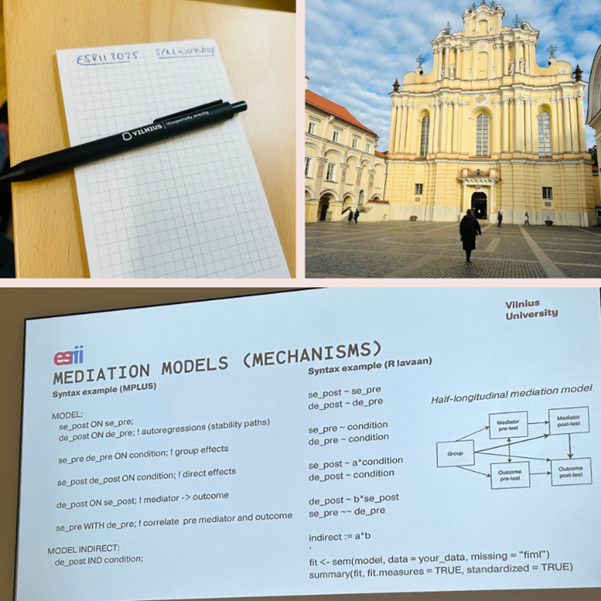
After the workshop, I attended a pre-conference social event at a local bar. This was a fun evening where I had the opportunity to meet conference attendees and chat about their work and experiences in mental health digital intervention.
——————————————————————————————————————————
Day One
On the first day of the conference, I soaked up as much information as possible from the excellent keynotes and wide variety of talks and poster presentations that were delivered.
Professor Marit Sijbrandij, who is based at the Vrije University in Amsterdam and the World Health Organisation’s Collaborating Centre for Research and Dissemination of Psychological Interventions, delivered an inspiring keynote. This was focussed on the use of scalable digital mental health solutions for people affected by crisis, such as war and displacement. Prof. Sijbrandij spoke about how low-intensity, evidence-based approaches can be delivered by non-specialists to reach those who may otherwise not have access to vital mental health support.
A further presentation session that I found particularly interesting focused on engagement and adherence in digital mental health interventions. The research presented drove home the message that we really need to be understanding the needs and preferences of those who we wish to benefit from our interventions. And we can do this by meaningfully engaging individuals in digital intervention development through iterative and inclusive co-design methods and early-stage formal evaluation.
Day Two
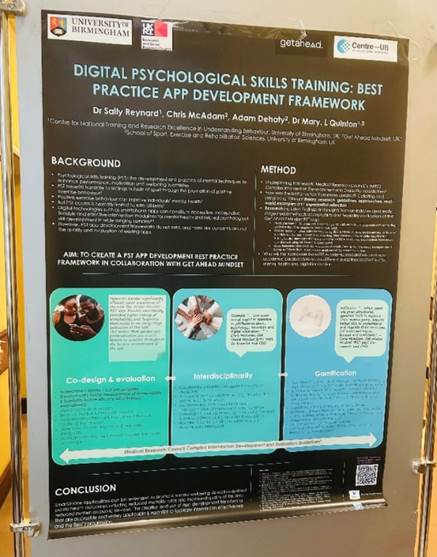
On the second day of the conference, I presented a poster on a new framework that I created within my Centre-UB Research Fellowship. The friendly and inclusive environment facilitated by ESRII made the experience really enjoyable.
What is the framework about?
The framework provides an evidence-based guide for both academic and non-academic interdisciplinary collaborators to facilitate the creation of acceptable, feasible, effective and scalable psychological skills training apps across different contexts.
How was it created?
Underpinned by the Medical Research Council’s Complex Intervention Development and Evaluation Guidelines2, the framework was informed by collating and integrating relevant theory, research, guidelines and approaches, as well as real-world examples and reflections based on my Fellowship work with sport psychology app start-up Get Ahead Mindset.
The research that I completed as part of my Fellowship—an early-stage acceptability and feasibility trial of Get Ahead’s new sport psychology psychological skills training app—also informed the framework. The mixed-methods approach that I took enabled me to gather both numerical data (from online rating surveys completed by app users) and text-based data (from transcripted individual interviews with app users). The nuanced understanding of acceptability and feasibility of the app generated by gathering the perspectives of different types of app users in different contexts with different types of data allowed me to provide comprehensive recommendations for the app’s ongoing development.
What does the framework recommend?
Comprising three core interconnected themes: 1) Co-design and evaluation, 2) Interdisciplinarity, and 3) Gamification, the framework provides practical tips and discussion on the key underpinning tenants of these themes within the context of creating effective psychological skills training apps.
Drawing on the key findings of the evaluation research that I completed as part of my Fellowship, the framework contains insights about the need for co-designed gamified elements to elicit optimal app engagement and acceptability. The need for personalisation and ability to understand and adapt to diverse user needs is also a fundamental recommendation for optimal app engagement and acceptability.
A central point to highlight is that app acceptability (how much the app is liked) helps to facilitate app effectiveness (how well it trains the skill(s) it aims to train). Therefore, placing a focus on how to generate optimal acceptability is extremely important as a foundational outcome of good app development.
As well as the fascinating keynotes, talks and poster presentations that formed day two of the conference, I also attended a roundtable event. Having not attended an academic roundtable before I was looking forward to finding out what the panel would talk about.
Chaired by Professor Evaldas Kazlauskas, Head of the Psychotraumatology Centre at Vilnius University and Chair of the ESRII Scientific Advisory Board, the timely discussion focused on the ‘Way forward for internet interventions during global challenges’.
I asked the panel about how they think we should integrate meaningful and rapid co-design within crisis environments given what we know about mental health interventions needing to be created with people in order for them to be effective. I am glad that I plucked up the courage as the discussion that followed was really interesting! Other questions and discussion topics focused on what we can do when there is no internet and the target population is unreachable in-person, and how we might best meet the needs of those who are experiencing trauma during disaster or conflict.
——————————————————————————————————————————
A conference highlight for me was getting to join the wonderful ESRII community, make new connections and chat to people who are also passionate about evidence-based technological innovation for mental health. This was topped off by getting to see the sights of Vilnius with a guided tour from the conference organisers, marking the end of the conference.
We explored the Cathedral Square, Gedimino Tower, River Neris, the city walls and the Constitution of the Republic of Užupis, finished off with some lovely food at a local food market and drinks at a bar.

As the tourism tagline states, Vilnius was well and truly ‘Unexpectedly Amazing’! I was so glad that I got to explore the city as well as engage with cutting edge research in mental health digital intervention throughout my time at the conference.
You can find out more about visiting Vilnius here.
——————————————————————————————————————————
Are you interested in attending an academic conference? Why not have a look at Centre-UB’s upcoming conference ‘Building Capability in Behavioural Research Conference 2026’, planned in collaboration with Behavioural Research UK.
Want to get in touch with Sally and keep up to date with her work? Find her on LinkedIn.
——————————————————————————————————————————
References
- Reynard, S., Dias, J., Mitic, M., Schrank, B., & Woodcock, K. A. (2022). Digital Interventions for Emotion Regulation in Children and Early Adolescents: Systematic Review and Meta-analysis. JMIR Serious Games, 10(3), e31456.
- Skivington, K., Matthews, L., Simpson, S. A., Craig, P., Baird, J., Blazeby, J. M., Boyd, K. A., Craig, N., French, D. P., McIntosh, E., Petticrew, M., Rycroft-Malone, J., White, M., & Moore, L. (2021). A new framework for developing and evaluating complex interventions: update of Medical Research Council guidance. BMJ (Clinical Research Edition), 374, n2061.
——————————————————————————————————————————
Image credit: Dr Sally Reynard.
Written by Dr Sally Reynard, former Postdoctoral Research Fellow at Centre-UB, University of Birmingham.