
PhD Student: Alistair Parr; Partner: Birmingham City Council; Supervisors: Prof. Yuli Shan, Prof. Zongbo Shi and Dr. Suzanne Bartington; School of Geography, Earth and Environmental Science
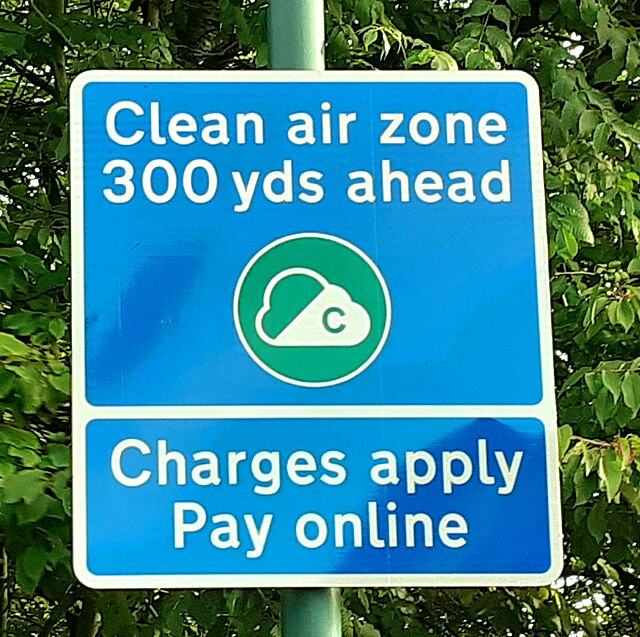
This project aims to explore how effective Clean Air Zones (CAZ) are in incentivising transport users to transition away from fossil fuel cars and towards less polluting modes of transport. CAZ’s are designated areas within a city drivers of polluting vehicles that enter are charged to improve air quality and public health. Since the UK is aspiring to reach net zero by 2050, decarbonising the transport industry is essential, hence understanding how to change transport behaviour is of vital importance.
The research will focus on creating models figures using data provided by Birmingham City Council to understand how Birmingham’s transport trends have changed in the four and a half years since the CAZ was launched. By analysing these trends, Birmingham’s CAZ will be used as a case study to uncover how viable CAZ are in reaching net zero, and if it is worthwhile introducing more CAZ across the UK. For instance, the research might reveal that whilst CAZ reduce domestic transport emissions in the UK, the consequences of people replacing their fossil fuel cars with electric ones (or purchasing a second EV) could increase supply chain emission outside of the UK, potentially counteracting the net reduction in emissions in the long term.
Since Birmingham’s CAZ will be used as a case study, this project will collaborate with Birmingham City Council, to address real-life issues such as logistics, transport pollution and the feasibility of Birmingham city reaching net zero by 2030. Similarly, partnering with Birmingham City Council ensures that research collected from this project can be seamlessly integrated into policy recommendations.
In terms of broad impact, the projects research can be used to evaluate if CAZ should be implemented in every city in the UK or even in the whole of Europe and the effect this would have on reducing domestic transport emissions.